1931 Las Vegas Gambling Legalization, Hoover Dam & Pair-O-Dice
Read Article →
Vintage Las Vegas Casino Chips, Linen Postcards & Matchbooks: Authentication Guide
Authenticating vintage Las Vegas casino chips, linen postcards, and matchbooks issued between Nevada's March 19, 1931 gambling legalization and June 1987 relies on three physical diagnostics: compression-molded clay edge impressions (such as T.R. King Crown and Christy & Jones Hat & Cane molds), alphanumeric printer ciphers inside Curt Teich postcard stamp boxes, and the 1973–1978 federal safety shift from front-striker to reverse-striker matchbook covers. After the Nevada Gaming Commission adopted Regulation 12 in June 1987, mandating state-witnessed industrial shredding of all unredeemed gaming checks upon a casino's closure, pre-1987 table chips from vanished properties like the 1946 Flamingo and 1955 Moulin Rouge became finite numismatic artifacts.
Because modern Chinese ABS plastic fantasy chips, color-laser postcard reprints, and commemorative gift-shop souvenirs flood online auctions, visual graphics alone cannot verify age. Examining rim tooling under a 10x loupe, testing center inlays with a magnet and gram scale, and reading factory production codes allow any researcher to separate genuine mid-century floor artifacts from worthless reproductions in seconds.

Historical photograph of Casino Chips.
In This Article • 5 Archival Photographs
Click any photo to view full size
Archival Landmark Dossier
Authentic Clay Chip Weight
8.5 to 10.5 grams (non-magnetic mineral-clay composite; zero steel slug)
Premier 1940s–50s Molds
T.R. King Small/Large Crown; Christy & Jones Hat & Cane; Burt Crest & Seal
Chip Destruction Cutoff
June 1987 (Nevada Gaming Regulation 12 mandated witnessed crushing)
Curt Teich Linen Era
1931–1955 ('C.T. Art-Colortone' coded [Year][Decade Letter]-H...)
Matchbook Striker Cutoff
1973–1978 (CPSC safety shift moved grit striker from front lip to back)
Top Auction Rarities
1946 Siegel Flamingo, 1955 Moulin Rouge & Tallyho checks ($1,000–$25,000+)
How Do You Identify T.R. King, Christy & Jones, and Burt Edge Molds on Vintage Clay Chips?
From the 1930s through the 1980s, legitimate Nevada casino checks were never injection-molded out of modern ABS plastic. Instead, specialized gaming suppliers mixed natural mineral clays, chalk, silica, resin binders, and metallic oxide pigments (including heavy lead oxide formulas discontinued in the late 1990s), inserted die-cut colored edge-spot plugs and textured paper center inlays, and pressed each 39-millimeter disc under heated hydraulic steel dies. That compression press left a microscopic recessed signature, the edge mold, around the outer ring of every authentic casino check.
| Manufacturer & Era | Signature Edge Mold Name | Loupe Diagnostic & Classic Las Vegas Casino Users |
|---|---|---|
| T.R. King & Co. (Los Angeles, 1940s–2006) | Small Crown (SCrown) & Large Crown (LCrown) | 16 tiny 3-point crowns (SCrown, c. 1942) or 12 wider crowns (LCrown, c. 1949) with razor-sharp square edges; used by El Rancho Vegas, 1946 Flamingo, Sahara, and 1955 Moulin Rouge. |
| Christy & Jones (Midwest, 1953–1965) | Original Hat & Cane (C&J THC) | 8 alternating top hats and canes; distinguished from post-1965 Paulson chips by smooth, glossy, deeply recessed hat crowns; used on 1950s Sands, Dunes, and Riviera checks. |
| Paulson Dice & Card Co. (Las Vegas, 1965–2014) | Paulson Top Hat & Cane (THC) & House Molds | Paul Endy bought C&J's presses in 1965; added crosshatched texture inside hat recesses and custom property molds for Caesars Palace, Mirage, and Horseshoe. |
| Burt Company (Portland, ME, 1930s–1985) | Diamond & Square, Crest & Seal, Rectangle | Pressed finished clay blanks sold via distributors like Nevada Novelty; ubiquitous across early Fremont Street halls (Las Vegas Club, Pioneer Club, Boulder Club). |
| Taylor & Co. / Mason & Co. (Chicago, 1930s–1960s) | T-Mold (Taylor) & H-Mold / Hub (Mason) | Repeating capital T or H letters stamped around rim; common on 1930s–1940s Highway 91 roadhouses and early Golden Nugget / Last Frontier low-denomination checks. |
Before inspecting the mold, run two instant bench tests: weigh the chip on a digital scale and touch a small neodymium magnet to its center. Genuine vintage compression-molded clay checks weigh 8.5 to 10.5 grams (occasionally dropping near 8.0 grams after decades of felt wear) and are completely non-magnetic, save for specialized brass-core $25/$100 security issues that still reject a magnet. Cheap tourist and home-poker chips weigh 11.5 to 13.5 grams because they conceal a stamped steel washer inside slick plastic, an instant disqualifier.

Historical photograph of Casino Chips.
How Did Nevada Gaming Regulation 12 (1987) Create $5,000+ Vintage Chip Rarities?
Prior to June 1987, Nevada gaming statutes treated retired casino chips almost like discarded office supplies. When a 1940s or 1950s club changed syndicate hands, went bankrupt, or rebranded, as when the Golden Slipper became the Silver Slipper in November 1950 or the Moulin Rouge padlocked its doors in November 1955, management routinely dumped wooden racks of obsolete clay checks into Lake Mead, buried them in desert trenches, or poured them straight into wet concrete foundations for Strip expansions (a source of "dug" chips unearthed during 1990s implosion excavations).
Concerned that unredeemed checks from closed properties were being altered or passed across active cages, the Nevada Gaming Commission adopted Regulation 12 in June 1987. Under Regulation 12.070, any closing Nevada licensee must establish an escrowed cash reserve, publish legal notices for a strict statutory redemption period (typically 120 days), and then surrender every remaining chip and slot token for witnessed physical destruction, pulverized into fine dust inside industrial shredders in front of Gaming Control Board agents, exactly as occurred after the closures of the Stardust (2006), Riviera (2015), and Tropicana (2024).
Consequently, surviving high-denomination ($25, $100, and $500) chips from short-lived pre-1987 halls command extraordinary prices at Casino Collectibles Association (CCA) auctions because gamblers rarely walked out of a 1950s pit pocketing a $100 check worth over $1,100 in modern purchasing power. Authentic 1946 Bugsy Siegel Flamingo checks, 1955 Moulin Rouge T.R. King Small Crown $25 and $100 issues, 1930s Pair-O-Dice / 91 Club hot-stamps, and ultra-scarce 1963–1964 Tallyho gaming test checks routinely realize $1,500 to over $25,000 apiece. Conversely, beware of mass-produced Dunes Golf & Country Club commemorative sets pressed in the late 1980s as pro-shop souvenirs: unlike live cage checks, those fantasy issues carry zero table wear and trade for a few dollars.

Hicks family, somewhere in Las Vegas, 19xx. AZO postcards with this stamp on back were produced circa 1904-1918.
How Do You Decode Exact Print Years on Curt Teich Linen Postcards & Frasher RPPCs?
Nothing dates a vanished Highway 91 motor court or Fremont Street neon sign more precisely than a vintage postcard, provided you read the printer's production cipher rather than guessing from a postmark mailed years after purchase. Between 1931 and the mid-1950s, Chicago printing titan Curt Teich & Company dominated American roadside imagery with its saturated, cross-hatched "C.T. Art-Colortone" linen postcards, printed via offset lithography on high-rag-content cardstock embossed to resemble canvas.
Inside the rectangular stamp box on the back (or occasionally along the lower front border), every Curt Teich card carries an alphanumeric job code formatted as [Year Digit][Decade Letter]-[Process Letter][Serial Number]:
1. Read the Decade Letter: A = 1930s (1930–1939), B = 1940s (1940–1949), C = 1950s (1950–1959), D = 1960s, and E = 1970s.
2. Pair with the Preceding Year Digit: A card stamped 1B-H1420 combines 1 + B = 1941 (the inaugural year of El Rancho Vegas). A code beginning 6B-H... dates to 1946; 0C-H... dates precisely to 1950; and 4C-K... dates to 1954.
3. Verify the Process Suffix: -H denotes genuine C.T. Art-Colortone linen stock (1931–1956), whereas -K marks Teich's glossy Kodachrome-based "Curteichcolor" photochrom cards introduced in the 1950s.
Equally prized by Nevada archivists are black-and-white Real Photo Postcards (RPPCs) shot across Las Vegas between 1931 and 1954 by Pomona, California photographer Burton Frasher Sr. ("Frasher Fotos"). Unlike lithographed linen cards, genuine Frasher RPPCs were contact-printed directly onto photosensitive silver-gelatin postcard paper: under a 10x loupe, an authentic RPPC displays smooth continuous gray tones with zero halftone dot matrix, and its reverse AZO or EKC (Eastman Kodak) stamp box reveals its era via tiny corner squares (four upward-pointing triangles for 1904–1918; two upward and two downward for 1918–1930; solid corner squares for 1926–1940s).

Hicks family, somewhere in Las Vegas, 19xx. AZO postcards with this stamp on back were produced circa 1904-1918.
How Does the 2-Second Matchbook Striker Test Separate Pre-1973 Casino Ephemera?
Casino matchbooks (handed out by the millions in 20-strike standard sizes, wide 30-strike and 40-strike "Royal Flash" billboards, and intricate die-cut "Feature" matchbooks shaped like slot machines or champagne bottles by Universal, Lion, and Diamond Match) carry a built-in federal regulatory timestamp that anyone can spot in two seconds without magnification.
Flip the matchbook over and locate the rough dark-brown phosphorus friction striker strip. From the 1920s until 1973, virtually every American matchbook placed the grit striker across the bottom front lip just above the metal staple. Because striking a match on the front while leaving the cover flap open routinely ignited the entire comb of match heads in the user's hand, Consumer Product Safety Commission (CPSC) hearings launched in 1973 pushed US matchmakers to relocate the friction strip to the reverse (back) side, a rule codified as mandatory federal law under 16 CFR Part 1202 in May 1978.
Therefore, any Las Vegas casino matchbook with a front-lip striker (especially paired with a pre-1963 two-digit postal zone or no five-digit ZIP code, or a pre-1960 DUdley / 382- telephone exchange rather than a 702 area code) is guaranteed pre-mid-1970s stock, whereas any reverse-striker matchbook dates from the mid-1970s onward.

Historical photograph of Casino Chips.
Frequently Asked Questions
How can you tell if an old Las Vegas casino chip is real clay or fake plastic?
Perform two non-destructive tests with a pocket scale, a small magnet, and a 10x loupe. Authentic 1931–1980s Nevada casino chips are compression-molded mineral-clay composites weighing 8.5 to 10.5 grams with sharp 90-degree edges, distinct manufacturer rim molds (such as T.R. King crowns or Hat & Cane), and zero magnetic pull. Cheap modern souvenir or counterfeit chips weigh 11.5 to 13.5 grams due to a hidden magnetic steel slug.
Can you still cash in vintage chips from closed Las Vegas casinos like the Stardust or Tropicana?
No. Under Nevada Gaming Commission Regulation 12 (enacted in June 1987), when a licensed casino closes or retires a chip series, it sets a state-approved redemption window, typically 120 days at a designated partner cage, after which all unredeemed gaming checks become legally void as currency and remaining vault inventory is shredded under state supervision. However, obsolete chips almost always carry higher collector value than their original face value.
What does a code like 6B-H or 1C-H mean on a vintage Las Vegas linen postcard?
On postcards printed by Chicago's Curt Teich & Co., the stamp-box code identifies the exact print year and process. The first digit gives the year within the decade, while the letter gives the decade ('A' for 1930s, 'B' for 1940s, 'C' for 1950s), and '-H' indicates C.T. Art-Colortone linen paper. Thus '6B-H' was printed in 1946, while '1C-H' was printed in 1951.
Why do vintage Las Vegas craps dice have a small hole or circle stamped on them?
Precision 0.750-inch cellulose-acetate craps dice are retired after roughly one shift on a live table so microscopic corner nicks cannot alter roll probabilities. Before selling retired table dice in casino gift shops, security personnel drill, punch, or scribe a 'cancel mark' across one face so a cheater cannot palm the retired cubes and switch them back into an active craps game.
Curated Historical Bibliography
Recommended Las Vegas History Books
Recommended historical books and architectural studies covering this landmark. As an Amazon Associate, LasVegasArchive.com earns from qualifying purchases.
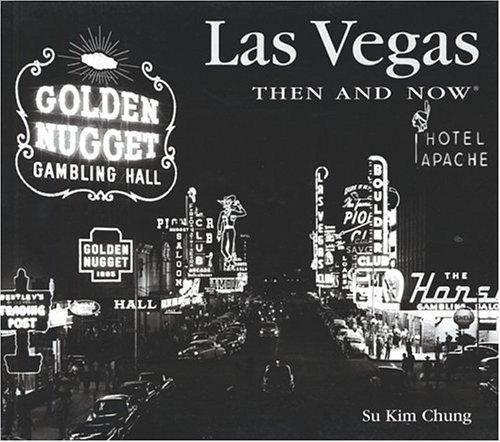
Las Vegas Then and Now
Reproduces dated UNLV archival photographs and vintage postcards essential for cross-checking Strip marquee changes against Curt Teich print codes.
View Hardcover on Amazon ↗
Blood Aces: The Wild Ride of Benny Binion, the Texas Gangster Who Created Vegas Poker
Illuminates the high-stakes pre-Regulation 12 cash, horseshoe check, and craps pit security culture of Benny Binion's Downtown Fremont Street.
View Hardcover on Amazon ↗
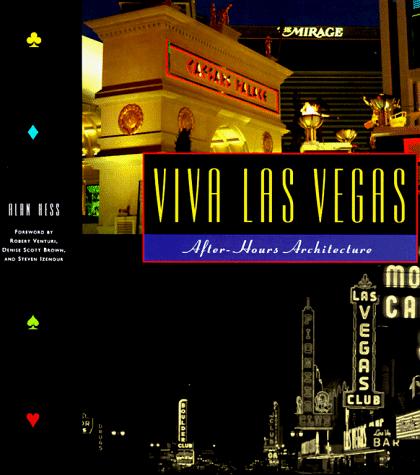
Viva Las Vegas: After-Hours Architecture
Connects casino graphic identity, from matchbook covers and swizzle sticks to roadside neon, into a unified mid-century design system.
View Hardcover on Amazon ↗
1905–1939 • Early Las Vegas
5 Photos

1955–1960 • Civil Rights & Westside Era
5 Photos

Moulin Rouge Hotel Las Vegas: 1955 Resort & 1960 Agreement
Read Article →
1945–1993 • Luxury Strip Origins
5 Photos

Flamingo Las Vegas History: Billy Wilkerson & Bugsy Siegel
Read Article →
1959–Present • Roadside Landmarks
5 Photos

Welcome to Fabulous Las Vegas Sign History & Betty Willis
Read Article →
